
How to Prepare for an EPC Assessment: A Berkshire Homeowner’s Checklist for 2026
The short answer
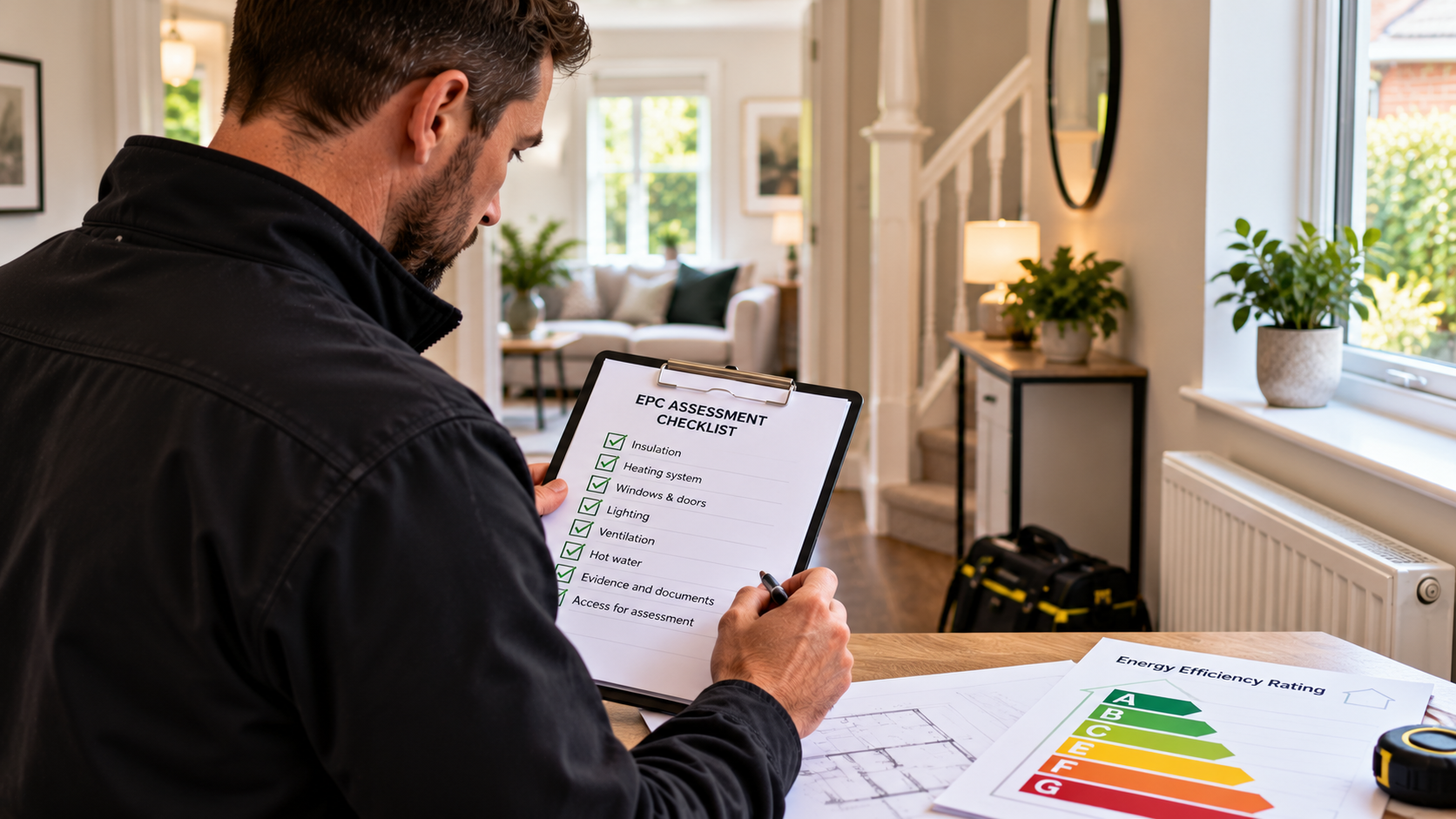
To prepare for an EPC assessment, do three things. First, gather your paperwork: FENSA or CERTASS glazing certificates, cavity wall insulation guarantees, loft insulation invoices, boiler installation records, solar panel MCS documents and Building Control completion certificates for any extension. Second, clear access to the loft hatch, the boiler, the hot water cylinder and every room, including the garage and any outbuilding attached to the house. Third, swap any remaining halogen or incandescent bulbs for LEDs, because since June 2025 assessors count bulbs individually rather than fittings. Preparation does not change your property, but it changes what the assessor is allowed to enter, and undocumented improvements are scored using conservative default values that will cost you points.
Frank EPC covers the whole county, and you can book an EPC in Berkshire online in about two minutes.
Why preparation matters more than it used to
This is the part most guides still get wrong, because they were written before the methodology changed.
Every EPC for an existing home is produced using RdSAP, the government approved calculation model for dwellings that are already built. New builds are assessed under full SAP instead, which is why a brand new property comes with its certificate already in hand. On 15 June 2025, RdSAP 10 replaced the previous version across England, Wales, Scotland and Northern Ireland, and it tightened the evidence hierarchy considerably. Assessors now record more dimensions, more construction detail and photographic proof of what they enter. Windows are measured and recorded individually rather than generalised. Lighting is counted by bulb rather than by fitting. Solar diverters and battery storage are formally recognised for the first time.
The practical consequence is simple. Under the old version, an assessor had more room to make a reasonable judgement about something they could not fully verify. Under RdSAP 10, if a feature cannot be seen, measured or evidenced, the model applies a default value, and RdSAP defaults must not be overwritten without documentary evidence of the actual specification.
Those defaults are deliberately conservative. They assume the worst plausible case, because the alternative would be a register full of optimistic ratings nobody could stand behind. So the homeowner who had cavity walls filled in 2016 and cannot find the guarantee is scored as though the walls were never filled at all.
That is not the assessor being difficult. It is the rules working exactly as designed. Which is why fifteen minutes with a folder of paperwork is the highest value preparation you can do.
What does an EPC assessor look at?
An EPC assessment is a non invasive visual survey. Nothing is drilled, lifted or dismantled. The assessor is building a data model of your home, and these are the inputs they need:
- Property age, type and construction. Detached, semi, terraced, flat or maisonette, the approximate build date, and the wall construction. Age band drives a lot of the default assumptions, so an accurate date matters.
- Dimensions. Room by room measurements to establish the total floor area and the heat loss perimeter. This is usually the longest part of the visit.
- Walls and insulation. Cavity, solid, timber frame or system built, and whether insulation is present and evidenced.
- Loft and roof. Insulation depth measured at the hatch, plus whether the loft is boarded, converted or a room in roof.
- Windows and doors. Every window individually: size, orientation, frame material, glazing type, glazing gap and approximate age.
- Main heating and controls. Boiler make, model and data plate, fuel type, radiators, thermostats, TRVs, programmers and smart controls.
- Secondary heating. Open fires, wood burners, electric heaters that are fixed or in regular use.
- Hot water. Combi, cylinder, cylinder insulation type and thickness, and any immersion.
- Lighting. The number of low energy bulbs as a proportion of the total.
- Renewables. Solar PV with MCS paperwork, solar thermal, heat pumps, batteries and PV diverters.
- Ventilation. Extract fans, flues, open chimneys and any mechanical ventilation.
If you want a sense of how long all of that takes and what the visit feels like on the day, our guide on how long an EPC takes walks through the timings.
Your EPC document checklist
Print this, or just pull the folder out the night before. Each row is a point of difference between a fair score and a default one.
| Document | What it evidences | What happens without it |
|---|---|---|
| FENSA or CERTASS certificate | Replacement glazing type and installation date | Glazing age is assumed from the property age band, and modern double glazing can be scored as older, poorer performing units |
| Cavity wall insulation guarantee (CIGA or installer) | That the cavity is filled | Walls are commonly scored as unfilled, one of the largest single hits to a score |
| Loft insulation invoice or receipt | Insulation depth where the hatch cannot be accessed | Default depth for the property age band is used, which is usually well below what you actually have |
| Boiler installation certificate or Gas Safe record | Boiler make, model and installation date | If the data plate is unreadable, an age based default efficiency applies |
| Solid wall insulation paperwork | Internal or external wall insulation | Solid walls are scored as uninsulated |
| MCS certificate for solar PV | Panel capacity and commissioning date | Panels may be recorded at a conservative default capacity, or missed entirely if not visible |
| Building Control completion certificate | Extension or conversion build standard and date | The extension is assumed to match the original property age band |
| Heat pump commissioning documents | System type, capacity and efficiency | Default efficiency figures apply |
| Previous EPC | Useful cross reference for the assessor | Nothing is lost, but it can save time |
Do not worry if you are missing some of these. Most homeowners are. FENSA certificates can be reordered online, CIGA guarantees can be requested by address, and your installer may still have records. If you know a job was done but cannot find the paperwork, tell the assessor anyway, because they can sometimes verify it visually where the evidence is clear.
What should I do the day before my EPC assessment?
Five practical steps, in order of how much they are worth.
- Find the paperwork. Everything in the table above, in one place. This is worth more than all the other steps combined.
- Clear the loft hatch. If the assessor cannot get a head and torch into the loft, insulation depth defaults. Move the boxes off the landing and put the pole somewhere you can find it.
- Unblock the boiler and cylinder. The data plate needs to be readable. If your boiler lives behind a stack of coats in the airing cupboard, move them.
- Swap the last old bulbs for LEDs. Since RdSAP 10 counts bulbs rather than fittings, a house with three remaining halogen spots in the kitchen scores slightly worse than the same house with LEDs throughout. It is a small gain, but it is the only genuine same day improvement on this list.
- Make sure every space is accessible. Garage, conservatory, loft room, cellar, outbuildings that share a wall with the house. Anything locked or blocked gets treated with assumptions rather than measurements.
That is it. There is no step six.
What will not improve your EPC rating on the day?
Worth saying plainly, because homeowners spend effort on the wrong things.
- Cleaning and tidying. An EPC scores the building fabric and the heating systems. Your hoovering is not an input.
- Turning the heating up before the visit. The assessment is a data survey, not a thermal comfort test. The internal temperature is irrelevant.
- Hiding an old boiler. The assessor needs the data plate. Concealing it produces a worse default, not a better score.
- Fresh paint, new carpets, new kitchen. None of these are RdSAP inputs.
- Being out of the house. You can leave a key with a neighbour, but you are the person who knows when the windows went in and where the cavity certificate lives. Being there is genuinely useful.
Anything that meaningfully moves a rating is a physical change to the fabric or the systems, and that takes weeks rather than hours. Our guide on how to improve your EPC rating covers what actually works and roughly what it costs.
Does preparing really change my EPC band?
Sometimes yes, often no, and it depends entirely on how much undocumented work has been done.
A 2015 new build with original everything has almost nothing to evidence, so preparation makes very little difference. A 1960s semi that has had cavity fill, a new boiler, replacement glazing and a loft top up over twenty years has a great deal to evidence, and the gap between a fully documented assessment and an undocumented one on that property can be the difference between two bands.
The properties most affected are exactly the ones Berkshire is full of: 1930s to 1980s housing stock that has been improved steadily by successive owners, where the paperwork has scattered along the way.
If you are close to a band boundary this matters commercially, not just on paper. A D that should have been a C affects how a green mortgage product prices, what a buyer’s surveyor flags, and whether a rental property is on the right side of the 2030 minimum standard. If you already hold a certificate that you think undersells the property, our guide on how to check your EPC certificate explains how to read the register and what to do about an inaccurate one.
Do I need to be at home for the EPC assessment?
Not legally, but we recommend it. Somebody needs to let the assessor in, and the visit goes faster and more accurately when the person who knows the property is standing there. A tenant or a neighbour can hold the key, but they cannot tell the assessor that the rear extension went up in 2009 or that the cavities were filled the summer before last.
If you genuinely cannot be there, leave the paperwork out on the kitchen table with a short note listing what was done and when. It is the next best thing.
Preparing for an EPC in Berkshire
Frank EPC works across Reading, Bracknell, Slough, Windsor, Wokingham, Maidenhead, Newbury and the villages in between. We see the same pattern constantly: a well improved 1970s house scoring lower than it should because the evidence disappeared with a house move or a loft clear out.
When you book with us we will tell you in advance exactly what to have ready, and we will take the time on the day to look at whatever you can produce rather than reaching for defaults.

Frequently asked questions
How do I prepare for an EPC assessment? Gather evidence of any improvements such as FENSA certificates, cavity wall insulation guarantees, loft insulation invoices and boiler paperwork, clear access to the loft hatch, boiler and every room, and replace any remaining halogen or incandescent bulbs with LEDs.
What does an EPC assessor look at? Property age, type and construction, room dimensions, wall and loft insulation, every window individually, the main and secondary heating, heating controls, hot water and cylinder insulation, lighting, ventilation and any renewables such as solar panels or a heat pump.
What documents do I need for an EPC? FENSA or CERTASS glazing certificates, cavity or solid wall insulation guarantees, loft insulation receipts, boiler installation or Gas Safe records, MCS certificates for solar, heat pump commissioning documents and Building Control completion certificates for extensions.
Do I need to tidy the house before an EPC assessment? No. An EPC scores the building fabric and the heating systems, not the decoration or cleanliness. Only clear enough clutter to give the assessor access to the loft hatch, the boiler, the cylinder and each room.
Can I improve my EPC rating on the day of the assessment? Barely. Swapping the last old bulbs for LEDs is the only meaningful same day change, because RdSAP 10 counts bulbs individually. Everything else that moves a rating is a physical upgrade that takes weeks.
What happens if I cannot find my insulation paperwork? The assessor applies the RdSAP default for your property age band, which usually assumes no insulation. FENSA certificates can be reordered online and cavity wall guarantees can be requested by address, so it is worth chasing before the visit.
Does the assessor need to get into the loft? They need to open the hatch and look in to measure insulation depth. They do not need to climb in or move boards. If the hatch is blocked or sealed, a default depth is used instead.
Do I need to be present for an EPC? Not legally, but it helps. You are the person who knows when the windows, boiler and insulation went in, and that information directly affects the score.
Has EPC assessment changed recently? Yes. RdSAP 10 took effect on 15 June 2025 across the UK and requires more measurement, more photographic evidence and stricter use of defaults where evidence is missing. The larger reform replacing the A to G rating under the Home Energy Model has been delayed to the second half of 2027. The October 2030 minimum band C standard for privately rented homes is unchanged.